The Europubhealth+ Erasmus Mundus Scholarship 2027 supports selected students in a two-year European Master in Public Health. The award covers participation fees and health and accident insurance, and provides a monthly allowance of up to €1,400. For the 2027–2029 intake, submit your complete scholarship application by 8 January 2027 at 13:00 Central European Time (CET).
Your choice of study pathway matters from the start. You pick a first-year university and a second-year specialisation, and that combination decides which language evidence you need. Someone starting in Dublin or Sheffield faces a higher English requirement than someone starting in Liège or Granada. Citizens of Cameroon, Afghanistan, Myanmar and Sudan also need to avoid Sheffield because of the UK’s student visa restriction.
This guide explains how to compare the seven specialisations, work out which language rules apply to you, and prepare a complete application. It also covers the interview, results and the later self-funded round.
Europubhealth+ Scholarship 2027 at a glance
| Item | Details |
|---|---|
| Programme | Europubhealth+ European Master in Public Health |
| Intake | 2027–2029 |
| Duration | Two years, full-time |
| Qualification | 120 ECTS and a double master’s degree, one from each host university |
| Who can apply | Graduates from any country with a bachelor’s degree of at least 180 ECTS or a certified equivalent |
| Scholarship deadline | 8 January 2027 at 13:00 CET |
| Scholarship benefits | Participation fees, health and accident insurance, and up to €1,400 per month |
| Scholarship interview | 18 February 2027, for the highest-ranked applicants |
| Scholarship-round results | Mid-March 2027 |
| Self-funded deadline | 24 March 2027 at 13:00 CET |
| Self-funded results | Mid-May 2027 |
What is the Europubhealth+ master’s programme?
Europubhealth+ is an Erasmus Mundus Joint Master delivered by a consortium of European universities and schools of public health. It looks at health at the population level. Students learn to ask why health outcomes differ between communities, how health systems allocate resources, and whether a policy or programme achieves what it set out to do.
The first year builds a foundation in public health. In the second year you specialise in an area such as epidemiology, health data, prevention or the economics of health systems, and complete an internship of three to six months and a master’s thesis. Each academic year ends with a three-week integration module in Rennes, France, taught in English.
Graduates receive two master’s degrees, one from their first-year university and one from their second-year university, plus a joint certificate and diploma supplement from the consortium.
The programme takes students from very different backgrounds. A nurse might bring experience from community care, while an economics graduate might bring skills in evaluating public spending. Someone from statistics might want to apply quantitative methods to population health. Whatever your field, your application should show what you already know and what you need the programme to teach you.
What does the Erasmus Mundus scholarship cover?
| Benefit | What selected scholarship holders receive |
|---|---|
| Participation fees | Full coverage of the programme’s participation fees |
| Monthly allowance | Up to €1,400 per month, which adds up to a maximum of €33,600 over 24 months |
| Insurance | Health and accident insurance that meets Erasmus Mundus requirements |
The allowance has to cover rent, food and travel between study locations. Since it’s paid monthly, set money aside for upfront costs such as a housing deposit, your visa and the trip to your first university.
Competition is intense. The consortium says fewer than 1% of applicants receive an Erasmus Mundus scholarship, and admission can come without funding. If you have held an Erasmus Mundus Joint Master scholarship before, you cannot receive another one.
If you are comparing funded master’s degrees across disciplines, the AMASE Erasmus Mundus scholarship guide shows how another consortium handles full and partial awards and sets deadlines by entrance university.
Who can apply for Europubhealth+ in 2027?
You need a bachelor’s degree worth at least 180 ECTS, or a certified equivalent. If your university uses a different credit system, your transcripts should show clearly what you studied, at what level and for how long. The consortium assesses equivalence itself.
Any academic discipline is accepted. Current students come from health fields such as medicine, pharmacy, biology and nursing, from social sciences such as economics, sociology, psychology, law and political science, and from business administration. Be aware, though, that biostatistics and epidemiology sit at the core of the programme, and the consortium expects a sufficient level of numeracy.
You must also prove the languages your pathway requires. The first-year and second-year universities must be in different countries, so you will study in at least two European countries.
Can Cameroonians apply for Europubhealth+ in 2027?
Yes, but not through Sheffield. In March 2026 the UK government stopped issuing student visas to citizens of Afghanistan, Cameroon, Myanmar and Sudan, and the consortium asks applicants from these four countries to choose another partner university for year one.
For an English-speaking Cameroonian, the practical route is University College Dublin in year one, followed by an English-taught specialisation in Rennes, Bordeaux, Maastricht or Kraków. None of the second-year specialisations is in the UK, so the restriction only changes your first-year choice.
The Dublin route needs IELTS Academic 6.5 with at least 6.0 in each skill, or an equivalent TOEFL, PTE or Cambridge score, taken on or after 28 September 2025. A medium-of-instruction letter from a Cameroonian university is not accepted on this route. Book your test early enough for the result to arrive before 8 January 2027. Applicants with B2 French, which includes many Francophone Cameroonians, can also consider Liège for year one.
First-year universities and teaching languages
| First-year university | Country | Teaching language |
|---|---|---|
| University College Dublin | Ireland | English |
| University of Sheffield | United Kingdom | English |
| University of Liège | Belgium | French |
| University of Granada and the Andalusian School of Public Health | Spain | Spanish |
All four build the same public health foundations, so start with the language you can prove. Then check that your first-year country differs from the country of your chosen specialisation.
Take an applicant who wants Public Health Data Science in Bordeaux. They could start in Dublin, Sheffield or Granada, or in Liège with B2 French. Each option changes the language evidence required, so settle the full route before you book a test.
The seven second-year specialisations
| Specialisation | Host institution and location | Language |
|---|---|---|
| Advanced Biostatistics and Epidemiology | EHESP School of Public Health, Rennes, France | English |
| Health and Environment in a Context of Climate Change | EHESP School of Public Health, Rennes, France | English |
| Public Health Data Science | ISPED, University of Bordeaux, France | English |
| Leadership in European Public Health | Maastricht University, the Netherlands | English |
| Governance and Economics of Health Systems in Transition | Jagiellonian University, Kraków, Poland | English |
| Health Promotion and Prevention | EHESP School of Public Health, Rennes, France | French |
| Health Services Management and Digital Transformation | University of Granada and EASP, Spain | Spanish |
Think about the work you want to do afterwards. If you want to design studies or interpret disease patterns, compare Advanced Biostatistics and Epidemiology with Public Health Data Science. A student interested in disease surveillance, for instance, could explain whether they lean towards study design or towards analysing routinely collected data.
Kraków suits applicants interested in how health systems raise and spend money. The Rennes climate specialisation fits those concerned with heat, pollution and environmental hazards. If you want to design and evaluate prevention programmes, the French-taught Health Promotion route is the natural choice. Remember that Granada cannot be both your first-year and second-year university.
Europubhealth+ language requirements for 2027
The consortium sets English requirements by pathway. The highest bar applies when you start in Dublin or Sheffield. Starting in Liège or Granada lowers the English threshold, but then you must also prove French or Spanish. Every route still needs English because the integration modules are taught in English.
| Pathway | IELTS Academic (overall / each skill) | TOEFL iBT (overall / each skill) | PTE Academic (overall / each skill) |
|---|---|---|---|
| Group A · Dublin or Sheffield in year one + any specialisation | 6.5 / 6.0 | 90 / 22, or 4.5 / 4.5 on the new scale | 63 / 59 |
| Group B · Liège or Granada in year one + Maastricht, Kraków, Bordeaux, or Epidemiology or Climate in Rennes | 6.0 / 5.5 | 80 / 20, or 4.0 / 4.0 on the new scale | 53 / 50 |
| Group C · Liège or Granada in year one + Health Promotion (Rennes or Granada) | 5.5 / 5.0 | 60 / 15, or 3.5 / 3.5 on the new scale | 51 / 41 |
Cambridge Advanced or Proficiency is also accepted: 180 overall with 175 per component for Group A, 169 and 165 for Group B, and 162 and 140 for Group C. Group C additionally accepts the Duolingo English Test with 95 overall and at least 85 per sub-score. IELTS One Skill Retake is not accepted for Group A.
English test dates and exemptions
For Group A, the test must be taken on or after 28 September 2025. For Groups B and C, the cut-off is 28 September 2024. What counts is the day you sat the test, not the day the results arrived.
Exemptions are narrow. You are exempt only if you are a citizen of one of the listed majority-English countries, such as the United States, the United Kingdom, Ireland, Canada, Australia or New Zealand. You are also exempt if you hold a completed degree fully taught in English in one of those countries or in Malta. For Dublin or Sheffield, that degree must have been issued on or after 29 September 2022.
A degree taught in English in Cameroon, Nigeria, Ghana or any other country outside that list does not exempt you on the Group A or Group B routes. The broader exemption applies only to Group C, where a previous degree fully taught in English in any country is accepted. Diplomas from online study never count as language proof.
French and Spanish requirements
Liège in year one and the Health Promotion and Prevention specialisation in Rennes require B2 French. Accepted proof includes DELF B2, DALF C1 or C2, and qualifying TCF or TEF scores taken on or after 1 September 2025. Citizens of majority French-speaking countries, and applicants whose secondary or higher education was in French, are exempt, although the consortium may check your level in an interview.
Granada requires B2 Spanish, whether it is your first-year university or your specialisation. DELE and SIELE results taken on or after 28 September 2024 are accepted. Citizens of majority Spanish-speaking countries and applicants educated in Spanish are exempt.
Europubhealth+ application documents
| Document | What to prepare |
|---|---|
| Identity document | A valid passport for non-European applicants. European applicants can use a valid passport or national ID. |
| CV | A current CV covering your education, work, research and relevant volunteering. Europass format is preferred. |
| Motivation letter | Up to 600 words in English, explaining why you chose Europubhealth+ and your specialisation. |
| Degree documents | Certified true copies of your degrees, a diploma supplement if available, and official or sworn English translations where needed. |
| Transcripts | Official transcripts and mark sheets in English from every higher education institution you attended. |
| Language evidence | Valid certificates for every teaching language in your chosen pathway. |
| Proof of residence | A residence certificate, an employer or university statement, or a utility, internet or housing bill showing your city and country, issued within 12 months before the deadline. |
Liège applicants also submit their high school certificate with a translation, plus official documents covering any activity of three months or more in the past five years. Once selected, non-European students going to Liège must show €10,000 a year in funds, and a scholarship certificate counts. Granada asks non-European students for a degree legalised by Apostille or by the Spanish Embassy. Start these early, because legalisation takes longer than uploading files.
How to apply for the Europubhealth+ scholarship
- Open the 2027–2029 campaign. Use the official portal linked at the end of this guide and select the round for Erasmus Mundus scholarship applicants.
- Select a valid pathway. Choose a first-year university and a second-year specialisation in a different country, then match your language evidence to that route. Citizens of Cameroon, Afghanistan, Myanmar and Sudan should not choose Sheffield.
- Complete the form in English. Enter your academic history and upload your documents. Check that names and dates match your official records and that every stamp and signature is readable.
- Finish your motivation letter. Keep it within 600 words and connect your experience, chosen specialisation and career plans through a concrete public health question.
- Submit before 13:00 CET on 8 January 2027. Leave time to replace a rejected upload. Afterwards, save your confirmation and application number.
A strong motivation letter starts with a problem you have actually seen. Perhaps a vaccination campaign reached fewer people in rural areas, or hospital records made it hard to compare outcomes between districts. Explain what you did or observed, which skills you now need, and why your specialisation provides them. That gives reviewers something specific to assess in 600 words.
How selection, interviews and results work
The selection committee, made up of representatives of the partner universities, first checks eligibility. It then ranks eligible applicants on five criteria: their reasons for choosing Europubhealth+ and the specialisation, their grades and distinctions, work experience in public health, health care or social work (volunteering and placements count), international projects or prospects, and personal skills such as adaptability, initiative and teamwork.
The best-ranked scholarship applicants are invited to a 15-minute online interview on 18 February 2027 with Europubhealth+ professors. Invitations go out a week before, and exact time slots four days before, anywhere between 08:00 and 20:00 CET. Dates and slots cannot be changed, so keep the whole day free.
To prepare, reread your application and practise explaining your pathway in plain language. Questions like these make good practice:
- What public health problem do you want to understand better, and how did you become interested in it?
- How would your first-year training and second-year specialisation help you investigate that problem?
- When have you worked with people whose training differed from yours, and what did you contribute?
Results come within nine weeks of each deadline, so expect the scholarship round in mid-March 2027. Selected applicants are told by email, and the anonymised numbers of unsuccessful applicants appear on the portal’s home page. If you were wrongly judged ineligible, you can appeal within 15 days by emailing europubhealth@ehesp.fr with “APPEAL”, your full name and application number in the subject line. The appeal covers eligibility errors only, not ranking.
Self-funded applications and tuition fees
If you can pay your own way or have another sponsor, the later round is open until 24 March 2027 at 13:00 CET, with results in mid-May. Anyone hoping for an Erasmus Mundus scholarship must apply in January.
| Fee category | Participation fees for two years |
|---|---|
| European students | €13,000 |
| Non-European students | €18,000 |
The European category covers citizens of the 27 EU countries, the UK, Iceland, Liechtenstein, Norway, North Macedonia, Serbia and Türkiye. Fees include teaching, library access, exams, the diploma and health and accident insurance, but not housing, food, travel or visa costs. On request, you can pay in three instalments each year: 40% by June, 30% by November and 30% by March.
Self-funded students may receive a fee waiver of up to 30%, based on merit and financial situation. If the January round admits you without a scholarship, you can apply for the waiver afterwards. In the March round, the waiver request is part of the application form.
If you are weighing up other joint master’s programmes, the CLMCE Erasmus Mundus scholarship guide shows why each consortium’s deadlines, documents and portal deserve their own check.
Frequently asked questions
Is the Europubhealth+ scholarship open for 2027?
Yes. The 2027–2029 scholarship round closes on 8 January 2027 at 13:00 CET. Older search results may still show January 2026 dates from the previous intake, so check the cohort on the portal.
Can I apply without a degree in medicine or public health?
Yes. Graduates from any discipline can apply if they meet the degree and language rules. Use your CV and motivation letter to link your experience to a population health question, and show that you are comfortable with numbers.
Can Cameroonians study the whole programme in English?
Yes. Start at University College Dublin and continue with an English-taught specialisation in Rennes, Bordeaux, Maastricht or Kraków. Sheffield is not an option for Cameroonian citizens while the UK student visa restriction is in place.
Is a medium-of-instruction letter accepted instead of IELTS?
Not for the Dublin, Sheffield or Group B routes, unless your degree comes from one of the listed majority-English countries or Malta. A previous degree fully taught in English in any country is accepted only for the Liège or Granada routes leading to Health Promotion and Prevention.
What should I check before submitting?
Confirm both universities, your language evidence for every teaching language, the date on your proof of residence, and the readability of your transcripts and translations. Submit before the deadline and save the confirmation.
Official application links
- Europubhealth+ application and selection procedure
- Europubhealth+ admission and language requirements
- Europubhealth+ official application portal
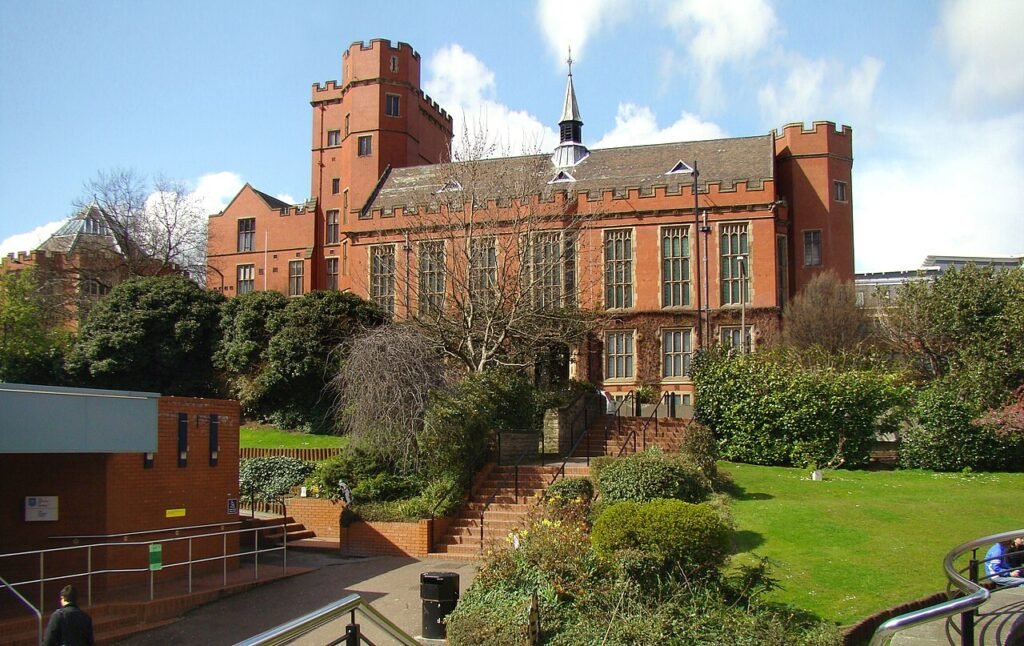
Featured image: University College Dublin campus. Photo by Alvarez Garrido via Wikimedia Commons, CC BY 4.0.