
The Commonwealth Shared Scholarships 2027/28 fund a one-year master’s degree at a participating UK university, covering tuition, a monthly stipend, return airfare and several study grants. Applications opened in November 2026 and close at 16:00 GMT on Tuesday 8 December 2026. That gives you only a few weeks, and you also need to secure admission to the course itself.
Before anything else, check your country. The scheme is open only to citizens of 43 listed Commonwealth countries. Nigeria, Ghana, Kenya, Uganda, Rwanda, South Africa and Tanzania are on the list. Cameroon is not, even though it is a Commonwealth member, so Cameroonian applicants should look at the alternatives near the end of this guide.
Commonwealth Shared Scholarships 2027 at a glance
| Item | Details |
|---|---|
| Funder | Commonwealth Scholarship Commission in the UK (CSC) and participating UK universities |
| Level | Taught master’s degrees only (no undergraduate or PhD study) |
| Duration | Normally 12 months |
| Study start | September/October 2027 |
| Application deadline | 16:00 GMT, Tuesday 8 December 2026 |
| Where to apply | CSC Central online application system, plus a separate admission application to the university |
| University nominations | March 2027 |
| Minimum degree | Upper second-class (2:1), or a 2:2 plus a relevant postgraduate qualification |
| Stipend | £1,712 per month, or £2,000 per month in the London area |
What the Commonwealth Shared Scholarship covers
The scholarship is “shared” because two bodies pay for it. The CSC funds the airfare and grants, while the host university pays the living allowance and the two agree the tuition arrangement between them. You pay no part of the tuition fee.
| Benefit | Details |
|---|---|
| Tuition fees | Full fees, covered by agreement between the CSC and the university |
| Living allowance | £1,712 per month, or £2,000 per month at universities in the London metropolitan area (current rates) |
| Airfare | Approved economy fare from your home country to the UK and back at the end of the award |
| Thesis grant | A contribution towards preparing your dissertation, where applicable |
| Study travel grant | Support for study-related travel within the UK or overseas |
| TB test | A contribution towards the mandatory tuberculosis test for the visa, with receipts |
| Child allowance | £622 per month for the first child and £154 for the second and third child under 16, for scholars who are widowed, divorced or single parents and whose children live with them in the UK |
Scholars who share that they have a disability are offered a full assessment for extra support. Family allowances are a contribution only, so anyone bringing a partner or children should expect to top up the funding from their own resources.
Eligible countries for 2027/28
Only citizens of, or refugees recognised by, the following countries can apply. You must also be permanently resident in an eligible Commonwealth country.
| Region | Eligible countries |
|---|---|
| Africa | Botswana, Eswatini, Gabon, Ghana, Kenya, Lesotho, Malawi, Mauritius, Mozambique, Namibia, Nigeria, Rwanda, Saint Helena, Sierra Leone, South Africa, Tanzania, The Gambia, Togo, Uganda, Zambia |
| Asia | Bangladesh, India, Malaysia, Maldives, Pakistan, Sri Lanka |
| Caribbean and Americas | Belize, Dominica, Grenada, Guyana, Jamaica, Montserrat, Saint Lucia, Saint Vincent and the Grenadines |
| Pacific | Fiji, Kiribati, Nauru, Papua New Guinea, Samoa, Solomon Islands, Tonga, Tuvalu, Vanuatu |
Cameroon does not appear on the 2027/28 list. Cameroonian citizens also face a separate obstacle: since March 2026 the UK has stopped issuing study visas to citizens of Afghanistan, Cameroon, Myanmar and Sudan. Until both of those change, UK master’s scholarships are not a realistic route for Cameroonians.
Who is eligible for the Commonwealth Shared Scholarship?
Beyond nationality, the CSC lists these conditions. You must:
- be a citizen of, or hold refugee status in, an eligible Commonwealth country, and be permanently resident in an eligible Commonwealth country;
- be available to start your studies in the UK by the beginning of the academic year in September 2027;
- by September 2027, hold a first degree of at least upper second-class (2:1) honours, or a lower second-class degree plus a relevant postgraduate qualification, usually a master’s;
- not have studied or worked for one academic year or more in a high-income country;
- be unable to afford UK study without this scholarship;
- submit every required supporting document in the correct format.
There is no age limit. Distance learning with a university in a high-income country while living at home does not count against you, but the form asks you to state clearly whether any earlier study abroad was done remotely.
The 2:1 rule trips up many applicants. In Nigeria and Ghana, for example, a Second Class Upper usually meets it. A Second Class Lower only qualifies if you also hold a relevant postgraduate degree. If your university uses a GPA scale, check how your result converts before you spend time on the essays.
Commonwealth Shared Scholarships 2027 eligible courses
You cannot pick any UK master’s. Universities bid for scholarships on specific courses with a clear development impact, and the CSC groups the approved courses under six development themes:
- Access, inclusion and opportunity
- Improving population health, health systems and capacity
- Promoting innovation and entrepreneurship
- Science and technology for development
- Strengthening peace, security and governance
- Strengthening resilience and response to crises
To give you a sense of the range, these are the approved courses under the first theme, Access, inclusion and opportunity:
| University | Course |
|---|---|
| Liverpool Hope University | MA Disability Studies |
| London School of Economics and Political Science | MSc Gender, Development and Globalisation |
| SOAS University of London | MSc Global Development |
| University of Bath | MSc International Development with Education |
| University of Edinburgh | MSc Comparative Education and International Development |
| University of Edinburgh | MSc Sport Policy, Management and International Development |
| University of Glasgow | MEd Adult Learning, Community Development and Youth Work |
| University of Glasgow | MSc Global Development |
| University of Hull | MA Special Educational Needs, Disabilities and Inclusion |
| University of Oxford | MSt Diplomatic Studies |
| University of Southampton | MSc Gerontology |
| University of Stirling | MSc Heritage |
| University of Surrey | MSc FinTech and Policy |
| University of Sussex | MA Gender and Development |
| University of Sussex | MA Power, Participation and Social Change |
The other five themes have their own lists, covering health, science, governance and crisis response. Open the official eligible courses page linked at the end of this guide, find your theme, and note the exact course title. You must apply for one of those courses, not a similar one at the same university.
How to apply for the Commonwealth Shared Scholarship 2027
There are two separate applications, and you need both.
- Choose an approved course. Pick from the official list and read the university’s own page for entry requirements and its admission deadline. You may apply to more than one course and more than one university, but you can accept only one scholarship.
- Apply for admission to the university. The scholarship does not replace the normal admission application. Some universities set earlier internal dates, so contact the university directly if its page is unclear.
- Register on CSC Central. The system uses two-factor authentication, so you need a smartphone or a second email account. After registering you receive a reference number in the format 01234-SSP-UK-15 and a passcode. Keep that email safe, because you need both details every time you log in.
- Draft your answers outside the system. The CSC publishes a template application form and a guidance document. Write and polish your answers in a separate file first, then paste them in. Refreshing the browser exits the form and loses unsaved work, so save often and use the system’s own back buttons.
- Upload all supporting documents and submit before 16:00 GMT on 8 December 2026. You cannot edit an application after submitting it, and the portal gets very busy in the final days.
After the deadline, the CSC shares applications with the universities. Each university selects its candidates and nominates them to the CSC in March 2027, and the CSC then checks their eligibility. Successful candidates are first told that they are provisionally selected, and the formal Confirmation of Award follows once admission terms are agreed.
Documents you must upload
A missing document makes your application ineligible. The CSC lists three mandatory items:
| Document | Requirement |
|---|---|
| Proof of citizenship | A valid passport or national ID card showing your photograph, date of birth and country of citizenship (or proof of refugee status) |
| Transcripts | Full transcripts for every higher education qualification, including current courses, with certified translations if not in English. Missing pages make the application ineligible. |
| References | At least two references in PDF format, signed and either on institutional letterhead or sent as an email showing the referee’s details clearly. You upload them yourself to CSC Central before the deadline. |
I learned the cost of a missing document the hard way. In 2018, I applied for a Commonwealth Master’s Scholarship through Cameroon’s nominating agency. I had written the essays and collected recommendations, but my file was not nominated because I had not attached a passport. I assumed it would only be needed after selection. Gather every document now, check each page, and upload complete files.
The form itself also asks for the names and positions of three referees. One must be your current employer if you work. Your uploaded references should come from people who know your academic ability and your development work well.
What to write in the application form
The form is long, and it rewards specific, connected answers. You will be asked to list your qualifications, up to 10 publications and prizes, and your employment history, explaining how your experience relates to the course. You will also write about:
- your award objectives and how the scholarship will meet each one;
- your career plans for the five years after the scholarship, and your long-term plans;
- a detailed plan of study;
- a personal statement on how your background drives you to make an impact at home, including any barriers you have overcome;
- your voluntary activities and the leadership opportunities you have had.
Make the answers fit together. A Kenyan public health officer applying for a gerontology master’s, for instance, should name a concrete problem, such as weak care for older people in county health facilities. They should then show how specific modules address it and describe the role they will take on after returning. Vague promises to “contribute to national development” score poorly.
How applicants are selected
Each university runs its own recruitment and puts forward a set number of candidates. The CSC assesses applications against three criteria:
- candidate merit;
- quality of the plan of study (the CSC calls it the research proposal);
- potential impact on the development of your home country.
The CSC publishes a detailed selection criteria document. Read it before writing, and link each answer back to these points.
How competitive is the Commonwealth Shared Scholarship?
The CSC does not publish an acceptance rate for this scheme. It is competitive because each university receives a limited number of scholarships for specific courses, and only candidates who meet the 2:1 standard and demonstrate development impact progress. Your best advantage is fit. Apply only for courses that clearly match your background and plans, and treat each university’s selection as a separate competition.
Conditions after you win the award
Several conditions apply once you accept the scholarship:
- The CSC does not require an IELTS test, but your university may set an English language condition.
- You must submit a Health and Disability Form before receiving the Confirmation of Award.
- You must meet all UK visa requirements and sign an undertaking to return home before your student visa expires.
- You must live in the UK throughout the award and get CSC approval before any overseas travel.
- Paid work needs advance CSC approval.
- You cannot hold another scholarship covering the same costs.
The CSC will consider extending your stay only if you move from the master’s to PhD study, under strict conditions. It does not support staying on to work after the award. Employees of the UK government, staff of the Association of Commonwealth Universities or the British Council, and their relatives are not eligible.
Alternatives for Cameroonian applicants
If you are Cameroonian, you cannot use this scheme for 2027/28, and UK study visas for Cameroonians are currently suspended. Look at fully funded master’s programmes elsewhere. The Europubhealth+ Erasmus Mundus Scholarship 2027 offers a public health master’s in Ireland, France, the Netherlands and Poland, with a scholarship deadline of 8 January 2027. If you are open to studying within Africa, the Mauritius Africa Scholarship Scheme 2027 is another government-funded route.
Frequently asked questions
Is the Commonwealth Shared Scholarship open for 2027?
Yes. Applications for the 2027/28 academic year are open on CSC Central and close at 16:00 GMT on Tuesday 8 December 2026, for study starting in September/October 2027.
Is the deadline 8 December or January 2027?
The official CSC deadline is 8 December 2026. Some videos and blogs mention mid-January 2027, but that date does not appear on the CSC’s 2027/28 page. A university can set an earlier admission deadline, never a later scholarship one, so plan around 8 December.
Who is eligible for the Commonwealth Shared Scholarship?
Citizens or recognised refugees of the 43 listed countries, permanently resident in an eligible Commonwealth country, with at least a 2:1 first degree (or a 2:2 plus a relevant postgraduate degree), who have not studied or worked for a year or more in a high-income country and cannot afford UK study otherwise.
Can Cameroonians apply?
No. Cameroon is not on the 2027/28 eligible country list, and the UK currently does not issue study visas to Cameroonian citizens.
Do I need IELTS?
The CSC does not require IELTS, but your chosen university may ask for proof of English as a condition of admission. Check the course page.
Can I apply for more than one course?
Yes. You can apply to several approved courses at different universities, but you may accept only one Commonwealth Shared Scholarship.
Is there an application fee?
The CSC charges nothing to apply through its online system. Be wary of anyone asking you to pay to submit a CSC application.
Official links
- Commonwealth Shared Scholarships – official CSC page
- 2027 eligible courses
- Participating university contacts
- CSC Central application system
- CSC selection criteria
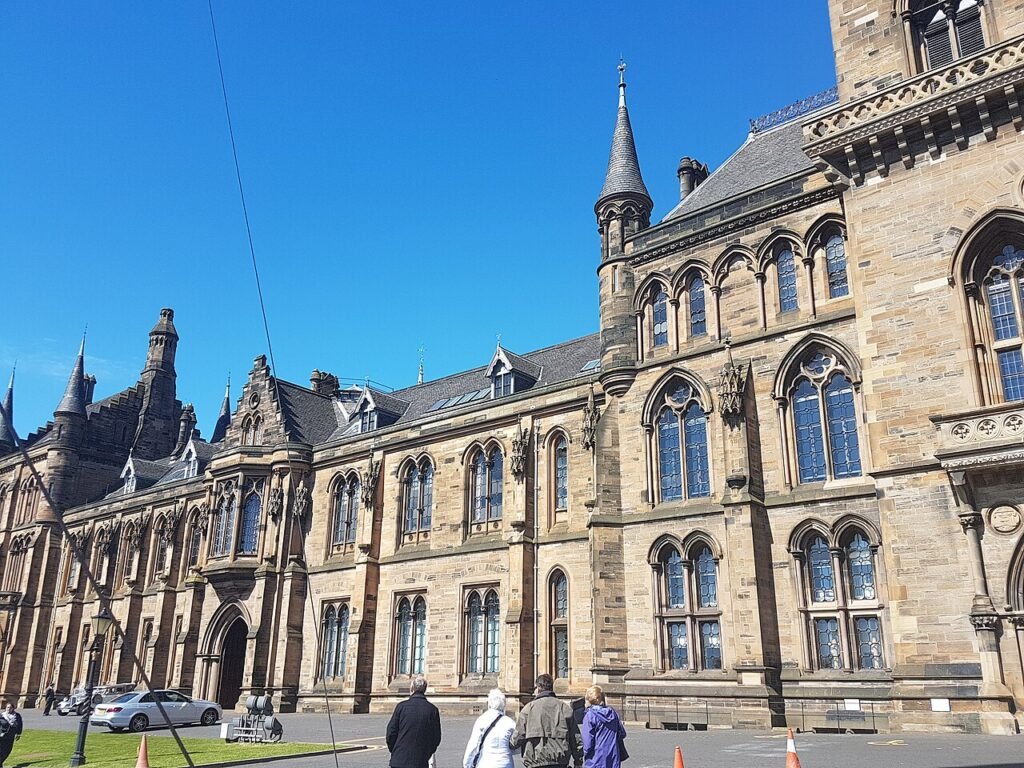
Featured image: Main Building, University of Glasgow. Photo by Stinglehammer via Wikimedia Commons, licensed under CC BY-SA 4.0.