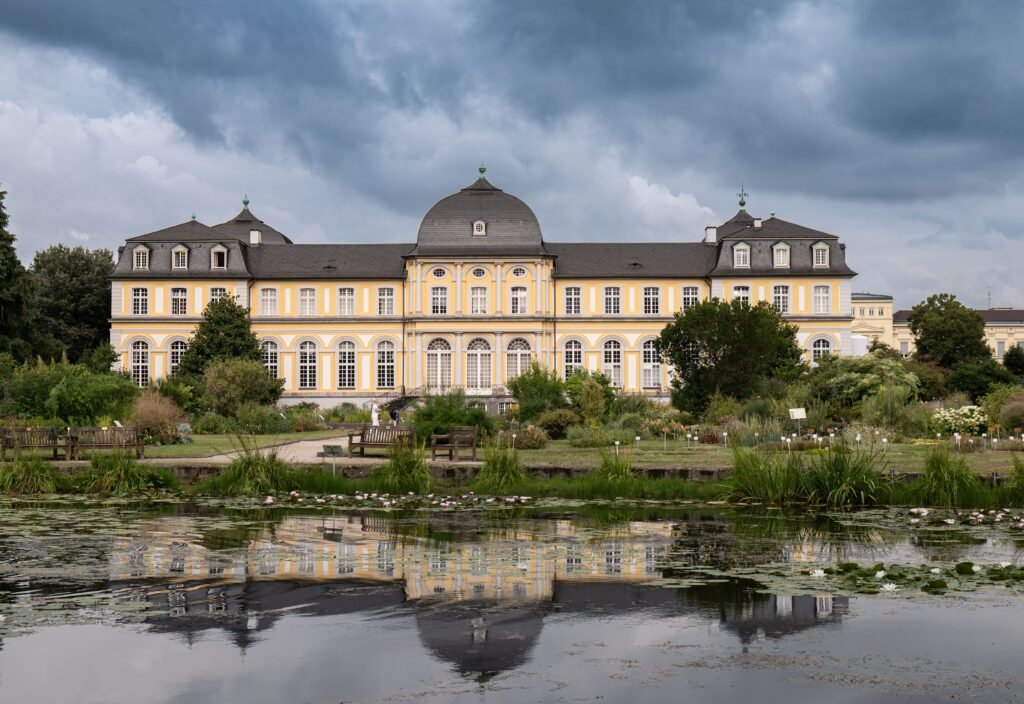
Applications are open for 10 University of Bonn Funded PhD Positions in Germany for 2027. The positions are part of the interdisciplinary Research Training Group “Urban Future – Managing Transformations for Better Health in Blue Cities.”
The programme brings together the University of Bonn and the Bonn-Rhein-Sieg University of Applied Sciences. It focuses on the connections between urban development, health, water, climate, governance and environmental sustainability.
Successful candidates will receive a four-year doctoral employment contract. Moreover, the positions are remunerated according to TV-L E13 at 65%. The programme also provides funding for fieldwork, research-related travel and other eligible research expenses.
International candidates can apply. Therefore, qualified applicants from Cameroon, Nigeria, Ghana and other African countries are eligible to compete for the positions.
The doctoral positions are expected to begin on April 1, 2027, while applications should be submitted by October 19, 2026.
University of Bonn Funded PhD Positions 2027 at a Glance
| Category | Details |
|---|---|
| Opportunity | 10 Doctoral Research Positions |
| Programme | Urban Future Research Training Group |
| Country | Germany |
| Main Institution | University of Bonn |
| Partner Institution | Bonn-Rhein-Sieg University of Applied Sciences |
| Number of Positions | 10 |
| Study Level | PhD |
| Duration | 4 years |
| Start Date | April 1, 2027 |
| Employment Level | 65% |
| Salary Grade | TV-L E13 |
| Research Funding | Fieldwork, travel and related research expenses |
| Programme Language | English |
| International Applicants | Eligible |
| Deadline | October 19, 2026 |
About the University of Bonn Urban Future Programme
The University of Bonn Funded PhD Positions 2027 are offered through the DFG Research Training Group “Urban Future – Managing Transformations for Better Health in Blue Cities”.
The programme examines how changes in cities can impact human health and well-being. In particular, researchers will explore the relationships between water, urbanisation, health, environmental conditions and social systems.
A major feature of the programme is its interdisciplinary approach. Instead of studying urban health from only one academic perspective, researchers from several disciplines work together.
As a result, candidates from public health, economics, environmental sciences, geography, development studies, computer science, agriculture, social sciences and several related fields may discover suitable research opportunities.
The programme is particularly interested in the challenfaced by Blue Citiesface. These are urban areas where rivers, coastlines and other water systems play an important role in the city’s development, environment and population health.
Four Main Research Themes
The doctoral programme is structured around four broad research themes. Consequently, applicants should develop projects that connect with at least one of these areas.
1. Urban Health Resilience
This theme examines how cities can become more resilient while protecting and improving human health.
For example, researchers may study how cities respond to climate change, environmental pressures, population growth and other major transformations.
The theme can therefore accommodate research involving health systems, climate resilience, urban planning, environmental management and sustainable development.
2. Urban Disease Ecology
The second theme focuses on the relationship between urban environments and diseases.
Research may examine infectious diseases, waterborne diseases, vector-borne diseases and antimicrobial resistance. In addition, candidates can explore how environmental and social conditions influence disease patterns in rapidly changing cities.
This area may particularly interest applicants with backgrounds in public health, microbiology, infectious diseases, environmental health and related fields.
3. Governance and Institutional Change
Urban transformation also depends on institutions and decision-making.
Therefore, this theme examines how policies, governments, organisations and other institutions influence urban development and health.
Research could address issues such as environmental governance, water management, public policy, development economics, institutional reform and urban inequality.
As a result, candidates from economics, management, development studies, political science and other social sciences may also consider the programme relevant.
4. Adaptive Urban Ecosystems
The fourth theme examines the relationship between urban development and ecological systems.
Researchers may investigate how cities can adapt to environmental pressures while maintaining healthy ecosystems and supporting human well-being.
Potential topics include land use, urban ecosystems, environmental change, biodiversity, water systems and sustainable urban development.
Funding and Employment Benefits
These opportunities are more accurately described as funded doctoral employment positions rather than conventional scholarships.
Successful candidates will receive employment for the four-year doctoral period.
The package includes:
- Four-year doctoral employment contract
- Salary according to TV-L E13 at 65%
- Funding for eligible fieldwork
- Funding for research-related travel
- Support for related research expenses
- Structured doctoral supervision
- Interdisciplinary research training
- Career-development opportunities
- Training in research methods
- Academic communication training
- Professional and transferable skills development
In addition, doctoral researchers will work within an international and interdisciplinary academic environment.
Depending on the individual doctoral project, employment will be based at either the University of Bonn or Bonn-Rhein-Sieg University of Applied Sciences.
Who Can Apply?
Applicants should hold a master’s degree or an equivalent academic qualification in a relevant discipline.
Suitable academic backgrounds include:
- Agricultural and Food Systems
- Climate and Earth Sciences
- Computer Science
- Development Studies
- Ecology and Life Sciences
- Economics and Management
- Environmental Sciences
- Geography
- Health Sciences
- Hygiene and Infection Control
- Infectious Diseases
- Mathematics
- Medical Microbiology
- Physics
- Public Health
- Social Sciences
- Urban and Regional Studies
Applicants from closely related disciplines may also be considered if their academic background and proposed research align with the programme’s objectives.
Furthermore, candidates should demonstrate an interest in interdisciplinary research. Their proposed project should connect clearly with urban transformation, health, water systems or related areas covered by the Research Training Group.
English Language Requirements
The doctoral programme is delivered in English. Therefore, applicants need strong written and spoken English skills.
Applicants are expected to provide evidence of English proficiency at the B2 level under the Common European Framework of Reference for Languages (CEFR) or an accepted equivalent.
Candidates should carefully check the application instructions to determine which forms of English-language evidence are accepted for their individual circumstances.
Can International and African Applicants Apply?
Yes. The University of Bonn Funded PhD Positions 2027 welcomes international applicants who meet the academic and research requirements.
Therefore, qualified candidates from Cameroon, Nigeria, Ghana and other African countries can apply.
The programme also has a strong international research network. Partner institutions are located in several countries, including:
| Country | Partner Institutions |
|---|---|
| Cameroon | University of Buea |
| Ghana | Universities participating in the programme’s research network |
| Togo | University of Lomé |
| Brazil | University of São Paulo |
| Japan | University of Tokyo |
Importantly, applicants do not need to be graduates of these partner universities.
Instead, these partnerships are part of a wider international research network that supports the programme.
Why the Programme Is Relevant to African Researchers
Rapid urbanisation is transforming many cities in Africa. At the same time, cities face challenges involving public health, water access, climate change, infrastructure, environmental management and urban governance.
Therefore, the programme’s Global South orientation opens up several possibilities for researchers interested in urban environments in Africa.
For instance, doctoral research could examine:
- Public health in rapidly growing African cities
- Water access and urban health
- Climate change and health
- Urban flooding
- Infectious diseases
- Environmental health
- Urban governance
- Sustainable urban development
- Health inequalities
- Waterborne diseases
- Urban resilience
- Land-use change
- Environmental economics
- Institutional change
Research is not limited to Germany. Applicants may propose suitable Blue Cities elsewhere, provided that the project aligns with the programme’s research framework.
What Will Doctoral Researchers Do?
Successful applicants will conduct independent PhD research while participating in the structured Research Training Group.
Their responsibilities may include:
- Developing an independent doctoral project
- Conducting academic research
- Collecting and analysing data
- Participating in interdisciplinary seminars
- Attending doctoral training activities
- Publishing research findings
- Participating in academic conferences and workshops
- Collaborating with researchers from other disciplines
- Contributing to the wider Urban Future research programme
- Participating in knowledge exchange activities
Therefore, the programme combines individual doctoral research with structured interdisciplinary training.
Required Application Documents
Applicants should prepare their documents carefully because several components are required.
The application package includes:
- Curriculum Vitae in tabular format
- University degree certificates
- Complete academic transcripts
- Information explaining the grading system used by previous universities
- Motivation letter of up to 500 words
- Research exposé of up to 1,500 words
- Interdisciplinary research statement of up to 500 words
- Two recommendation letters
- Evidence of English proficiency at B2 level
Among these documents, the research exposé is particularly important.
Applicants should use it to demonstrate that they have a clear doctoral research idea and that the proposed project fits the objectives of the Urban Future programme.
Preparing the Research Exposé
Applicants have considerable scope to develop a research project connected to their academic expertise.
However, the proposed research should clearly relate to the wider Blue Cities and urban-health framework.
Potential research areas include:
- Urban public health
- Climate change and health
- Water governance
- Environmental economics
- Infectious diseases
- Antimicrobial resistance
- Urban resilience
- Environmental management
- Urban ecosystems
- Health inequalities
- Sustainable urban development
- Urban planning
- Institutional change
- Land use and health
- Waterborne diseases
Applicants should avoid submitting a generic research proposal that has little connection with the Research Training Group.
Instead, they should explain how their project contributes to one or more of the programme’s four research themes.
Selection Process
The selection process consists of two main stages.
First, the selection committee will assess the submitted applications. Academic qualifications, research potential, interdisciplinary fit and the quality of the proposed doctoral project will therefore be important.
Afterwards, shortlisted candidates will be invited to a virtual interview.
Applicants should be prepared to discuss their research idea, academic background and motivation during the interview.
Moreover, candidates should be able to explain how their proposed research fits with the wider objectives of the Urban Future programme.
How to Apply for the University of Bonn Funded PhD Positions 2027
Applicants should begin by reviewing the programme’s research themes and determining how their academic background fits.
Next, candidates should develop a suitable doctoral research idea.
They can then prepare the required documents, including the research exposé, motivation letter and interdisciplinary research statement.
Thereafter, applicants should obtain the required recommendation letters and prepare their academic records.
Finally, the complete application should be submitted through the official application system before the deadline.
Applications should not be left until the final days. In particular, preparing a strong research exposé and obtaining two recommendation letters can take considerable time.
Application Deadline
The deadline for the University of Bonn Funded PhD Positions 2027 is:
October 19, 2026
The doctoral positions are expected to start on:
April 1, 2027
Applicants should therefore begin preparing their application documents as early as possible.
Frequently Asked Questions
Are the University of Bonn PhD positions fully funded?
The positions provide paid doctoral employment rather than a traditional scholarship. Successful candidates receive four-year contracts remunerated according to TV-L E13 at 65%. In addition, eligible fieldwork, research travel and related research expenses receive financial support.
How many PhD positions are available?
There are 10 doctoral research positions available through the Urban Future Research Training Group.
Can international students apply?
Yes. Qualified international candidates can apply.
Can Cameroonians apply?
Yes. Qualified candidates from Cameroon can apply. Furthermore, the programme’s international network includes the University of Buea in Cameroon.
Can Nigerians and Ghanaians apply?
Yes. Qualified applicants from Nigeria and Ghana can also apply because the positions are not restricted to German or EU nationals.
Is this programme only for public health graduates?
No. The programme is highly interdisciplinary.
Applicants may come from fields such as economics, development studies, environmental science, geography, agriculture, computer science, social sciences, climate science and several other disciplines.
Do I need a master’s degree?
Yes. Applicants should hold a relevant master’s degree or an equivalent academic qualification.
Is English proficiency required?
Yes. Applicants are expected to demonstrate English proficiency at approximately the B2 CEFR level or an accepted equivalent.
Can I conduct research in Africa?
Yes. Research may focus on suitable blue cities outside Germany. This makes the programme particularly relevant for researchers interested in urban transformation and health challenges in Africa and other Global South regions.
When does the programme start?
The doctoral positions are scheduled to begin on April 1, 2027.
Final Note
The University of Bonn Funded PhD Positions 2027 provide 10 opportunities for researchers interested in urbanisation, public health, water, climate, governance and environmental sustainability.
Successful applicants receive four years of paid doctoral employment at TV-L E13 (65%), alongside support for eligible fieldwork, research travel and related expenses.
Furthermore, the programme welcomes researchers from a range of academic disciplines and has a strong international and Global South orientation.
Qualified applicants from Cameroon, Nigeria, Ghana and other African countries can apply.
With the deadline set for October 19, 2026, interested candidates should begin preparing their research exposé, motivation letter, academic documents and recommendation letters early.
Official Links
University of Bonn – Official Vacancy:
https://www.uni-bonn.de/en/university/working-at-the-university/job-opportunities/vacancies-1/10-doctoral-research-positions-all-genders-in-the-interdisciplinary-field-of-urban-health
University of Bonn – Urban Future Programme:
https://www.uni-bonn.de/de/forschung-lehre/early-career/eine-promotion-planen/spps/urban-future