
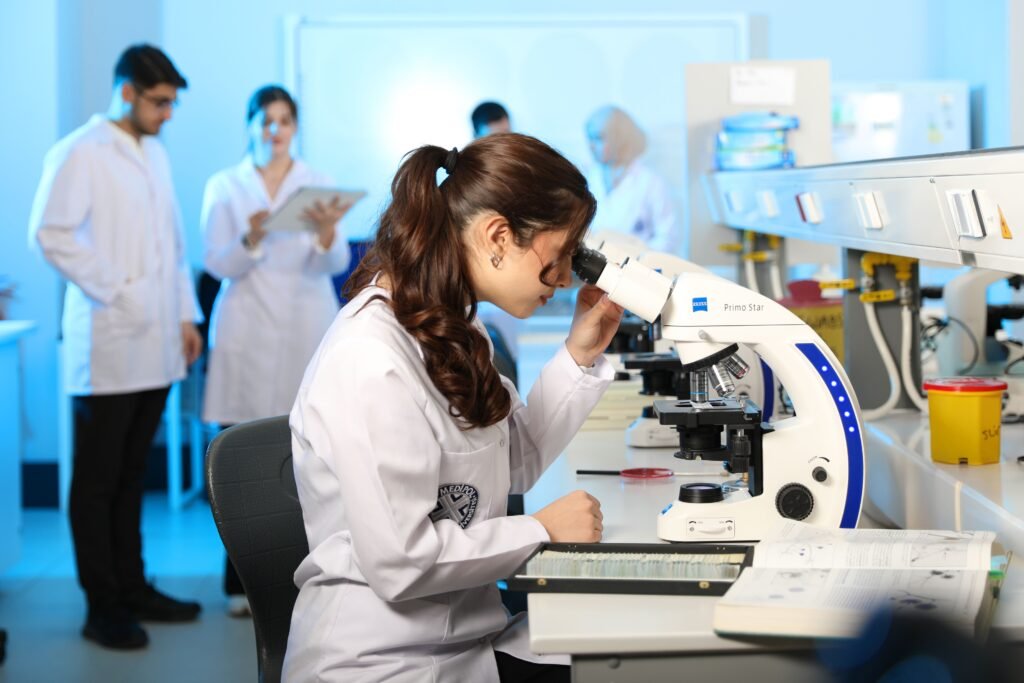
Applications are now open for the Neurasmus Erasmus Mundus Scholarship 2027, a fully funded opportunity for international students interested in pursuing a master’s degree in neuroscience in Europe.
The current call is for the Neurasmus 4.0 Cohort 2027–2029. Applications opened on 1 September 2026 and close on 1 December 2026 at 12:00 noon, Europe/Paris time.
The programme is open to international students from all over the world. This means eligible applicants from Cameroon, Nigeria, Ghana, Kenya, Uganda, South Africa and other African countries can apply.
The programme particularly encourages students with backgrounds in biomedical sciences, biology, chemistry, medicine, psychology, and related natural sciences to check their eligibility.
Neurasmus Erasmus Mundus Scholarship 2027 Overview
| Details | Information |
|---|---|
| Programme | Neurasmus – European Master in Neuroscience |
| Scholarship | Erasmus Mundus Joint Master Scholarship |
| Degree Level | Master’s |
| Field | Neuroscience |
| Cohort | 2027–2029 |
| Duration | 2 years |
| Eligible Nationalities | International students worldwide |
| African Applicants | Yes |
| Scholarship Allowance | €1,400 per month |
| Applications Opened | 1 September 2026 |
| Deadline | 1 December 2026 |
| Application | Online |
Is the Neurasmus Scholarship 2027 Fully Funded?
Yes. Candidates selected for the Erasmus Mundus Joint Master Scholarship receive comprehensive financial support.
The scholarship provides a contribution of:
€1,400 per month
The funding is intended to support expenses such as:
- Living costs
- Travel expenses
- Visa costs
- Installation expenses
In addition, holders of the Erasmus Mundus scholarship do not pay tuition fees or other mandatory participation costs associated with the programme.
Applicants should note, however, that admission eligibility does not automatically guarantee a scholarship. Erasmus Mundus funding is competitive and awarded to selected applicants.
Who Can Apply for the Neurasmus Erasmus Mundus Scholarship in 2027?
Applicants should hold a bachelor’s degree or equivalent in natural sciences or a related field.
Relevant backgrounds include:
- Biology
- Biomedical Sciences
- Chemistry
- Medicine
- Psychology
- Biochemistry
- Molecular Biology
- Physiology
- Neuroscience
- Other related natural sciences
Applicants are expected to have a solid academic foundation, particularly in biology, chemistry and mathematics.
Academic transcripts are therefore important because the selection committee can assess the individual courses applicants completed during their previous degree.
Can Biomedical Sciences Graduates Apply?
Yes, biomedical sciences are relevant to the programme’s stated natural-science requirements.
Applicants with biomedical sciences degrees may have studied subjects such as cell biology, molecular biology, physiology, biochemistry, anatomy, genetics, chemistry and mathematics, all of which can provide useful preparation for neuroscience.
Applicants should nevertheless check their individual transcripts because admission decisions are based on the applicant’s complete academic background rather than the degree title alone.
Can Biomedical Engineering Graduates Apply?
Potentially.
The programme accepts applicants from the natural sciences and related disciplines. Therefore, biomedical engineering graduates should not automatically exclude themselves.
Their eligibility may depend on the content of their degree. Applicants with substantial coursework in areas such as biology, physiology, mathematics, physics, biomedical systems, medical imaging or related sciences may have a relevant academic foundation.
Can Cameroonians, Nigerians and Ghanaians Apply?
Yes.
The Neurasmus Erasmus Mundus Scholarship is open to international students. Therefore, eligible applicants from African countries can apply, including students from:
- 🇨🇲 Cameroon
- 🇳🇬 Nigeria
- 🇬🇭 Ghana
- 🇰🇪 Kenya
- 🇺🇬 Uganda
- 🇿🇦 South Africa
- 🇪🇹 Ethiopia
- 🇹🇿 Tanzania
- 🇷🇼 Rwanda
- 🇸🇳 Senegal
- 🇨🇮 Côte d’Ivoire
- 🇿🇲 Zambia
- 🇿🇼 Zimbabwe
- and other African countries.
Applicants must still satisfy the academic and English-language requirements.
English Language Requirements
Applicants must demonstrate adequate English proficiency.
The current requirements include:
| Test | Minimum Score |
|---|---|
| IELTS Academic | 6.5 overall, no component below 6.0 |
| TOEFL iBT | 93 |
| TOEFL Paper-Based | 580 |
| TOEFL Computer-Based | 237 |
| Cambridge Advanced English | Grade B/C |
| Cambridge Certificate of Proficiency | Grade B/C |
There is also useful information for applicants who studied their previous degree in English.
The programme currently lists a letter from the applicant’s university confirming English as the medium of instruction among the accepted forms of English-language evidence.
Therefore, some applicants may be able to satisfy the English requirement through appropriate medium of instruction documentation instead of IELTS or TOEFL.
Documents Required for Neurasmus 2027
Applicants should prepare the required supporting documents carefully.
These include:
- Curriculum Vitae (CV)
- Motivation letter
- Academic transcripts
- Proof of English-language proficiency
- References
- Other information requested through the online application portal
The motivation letter should clearly explain the applicant’s interest in neuroscience, relevant academic preparation and future academic or professional goals.
Two Referees Are Required
Applicants also need two referees.
For the 2027–2029 application cycle, the reference process is particularly important because the reference forms are uploaded by the referees themselves.
Applicants cannot complete the final submission until the required referee forms have been received.
Therefore, applicants should contact their professors, thesis supervisors or research supervisors well before the deadline.
How to Apply for the Neurasmus Erasmus Mundus Scholarship 2027
Applications are completed online through the Neurasmus eMundus application platform.
Applicants should:
- Create an account on the application portal.
- Complete the online application in English.
- Upload the required supporting documents.
- Provide details for the required referees.
- Ensure the referees submit their forms.
- Review the application carefully.
- Submit before the deadline.
- Confirm receipt of the successful-submission email.
Applications sent by email or on paper are not accepted.
Official Neurasmus Application Portal
https://emundus-neurasmus.u-bordeaux.fr/campagne-info?cid=10&view=programme
Important Application Information
The current application instructions state that documents should be submitted in English and uploaded in the accepted formats.
Applicants should also avoid waiting until the last day because the referee submissions form part of the application.
If your application appears incomplete after uploading your documents, check whether both referees have submitted their required forms.
Neurasmus Scholarship 2027 Deadline
The deadline is:
1 December 2026 at 12:00 noon, Europe/Paris time
Applications opened on 1 September 2026.
Since references form part of the application, applicants should begin preparing their documents and contacting referees well before December.
What Makes a Competitive Application?
The Neurasmus Erasmus Mundus Scholarship is competitive. Meeting the minimum eligibility requirements does not guarantee selection.
A strong application may demonstrate:
- Excellent academic performance
- Relevant scientific coursework
- Research or laboratory experience
- Clear interest in neuroscience
- Strong motivation
- Good academic references
- Appropriate English proficiency
- Clear academic and career goals
Research experience can include an undergraduate thesis, laboratory projects, research internships, biomedical laboratory experience, research assistantships or related scientific projects.
Applicants without publications should not automatically exclude themselves. Research potential, academic preparation and motivation are also important.
Frequently Asked Questions
Is the Neurasmus Erasmus Mundus Scholarship 2027 open?
Yes. Applications for the 2027–2029 cohort are currently open and close on 1 December 2026.
Can Cameroonian students apply?
Yes. Cameroonian students are eligible to apply provided they satisfy the programme requirements.
Can Nigerian and Ghanaian students apply?
Yes. Applicants from Nigeria and Ghana can apply, as can eligible applicants from other African countries.
Can biomedical sciences graduates apply?
Yes. Biomedical Sciences is closely related to the natural-science background required by Neurasmus. Applicants should also ensure that their transcripts demonstrate relevant scientific preparation.
Can biomedical engineering graduates apply?
Potentially. Applicants should examine their coursework because eligibility depends on whether their academic background provides sufficient preparation for neuroscience.
What IELTS score is required?
The current requirement is IELTS Academic 6.5 overall, with no component below 6.0.
Can I apply without IELTS?
Potentially. The programme currently accepts a university letter confirming English as the medium of instruction as one form of English-language evidence.
How much is the scholarship?
Selected Erasmus Mundus scholars receive a contribution of €1,400 per month, while tuition and mandatory participation costs are not charged to scholarship holders.
Do I need references?
Yes. Two referees are required, and the referees submit their required forms through the application process.
Final Thoughts
The Neurasmus Erasmus Mundus Scholarship 2027 is an excellent opportunity for students interested in advanced training in neuroscience in Europe.
Applicants from Cameroon, Nigeria, Ghana and other African countries are eligible to apply, provided they meet the academic and English-language requirements.
The opportunity is particularly relevant to students from biomedical sciences, biology, chemistry, medicine, psychology and related scientific fields. Biomedical engineering graduates with appropriate scientific coursework may also be suitable candidates.
With Erasmus Mundus funding providing €1,400 per month alongside tuition and participation-cost coverage, successful applicants receive substantial financial support for their studies.
Deadline: 1 December 2026 at 12:00 noon, Europe/Paris time
Official Neurasmus Programme and Requirements
https://www.neurasmus.u-bordeaux.fr/admission/how-to-apply/
Apply for Neurasmus 2027–2029
https://emundus-neurasmus.u-bordeaux.fr/campagne-info?cid=10&view=programme



Pingback: Erasmus Mundus EU4M Scholarship 2027: Fully Funded Master's