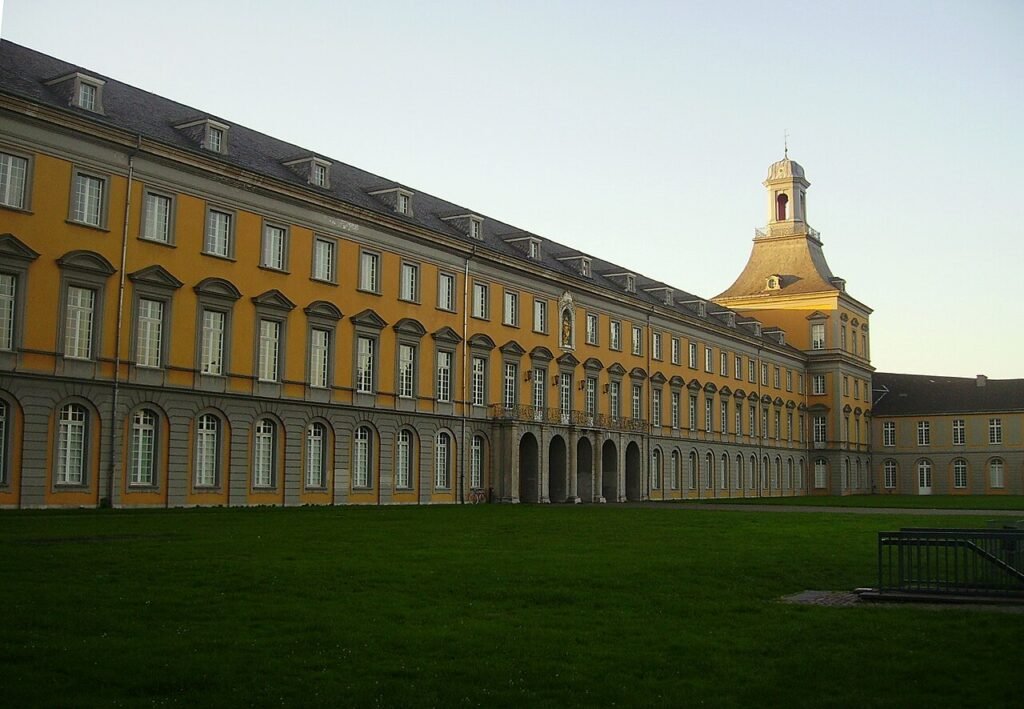
The BGSE PhD in Economics at the University of Bonn is open for the 2027 intake, and applications close on 15 January 2027. The Bonn Graduate School of Economics (BGSE) is one of the strongest economics doctoral programmes in Europe, and it offers grants to all successful applicants. You can apply with a bachelor’s degree. A master’s isn’t required.
It’s also demanding. BGSE asks for top-10% academic performance, a GRE quantitative score of at least 160, and strong English. If you meet those standards, this is one of the best-funded routes into a research career in economics in Germany.
Below, I’ll go through how the programme works, who can apply, the exact test requirements, the documents you need and how to strengthen your application.
BGSE PhD in Economics 2027 at a Glance
| Item | Details |
|---|---|
| Institution | Bonn Graduate School of Economics (BGSE), University of Bonn |
| Location | Bonn, Germany |
| Start | 1 October 2027 |
| Duration | About five years (MSc in Economic Research, then a three-year dissertation phase) |
| Funding | Grants available to all successful applicants, plus office space, conference travel funds and research stays abroad |
| Who can apply | Top-10% graduates with a bachelor’s or master’s in economics or a related field |
| GRE | Required. Minimum quantitative score: 160 |
| English | IELTS Academic 7.0, TOEFL iBT 100 (or 5.0 on the new scale) or Cambridge CAE. Exemption possible for degrees taught exclusively in English. |
| Language of the programme | English |
| Deadline | 15 January 2027 |
How the BGSE PhD in Economics Works
The programme runs for about five years, full time, in Bonn, in two stages:
- Stage 1: coursework and early research. You take demanding graduate courses in economics while starting your own research, and you earn an MSc in Economic Research.
- Stage 2: the dissertation phase. About three years of research, leading to a doctorate (Dr. rer. pol., equivalent to a PhD).
When you apply, BGSE considers you for two things at once: a BGSE grant, and a conditional offer to continue into the doctoral phase. That’s why you can join with only a bachelor’s degree. The first stage gives you the master’s-level training.
The department is one of the largest economics research centres in Europe. Its institutes cover applied microeconomics, microeconomic theory, macroeconomics and econometrics, and finance and statistics. It also runs the BonnEconLab for experimental economics and major research clusters such as ECONtribute and a research training group on the macroeconomics of inequality.
BGSE Funding: What Successful Applicants Receive
BGSE states that grants are available to all successful applicants. Alongside the grant, students get:
- Office space at the department
- Funding to present at conferences
- Opportunities for research stays abroad
BGSE doesn’t publish the grant amount on its application pages. You’ll see the exact figure in your offer. To be considered for a grant at all, you must submit a GRE score report and at least two letters of recommendation.
For international students, a funded offer matters for the German visa too. A grant that covers your living costs can be used as proof of funds, which can replace the €11,904 blocked account. Confirm with BGSE and the German embassy how your grant letter will be accepted once you’re admitted.
Who Can Apply for the BGSE PhD in Economics?
BGSE invites outstanding students in the top 10% of their cohort with a bachelor’s or master’s degree in:
- Economics
- Mathematics
- Statistics
- Business administration
- Accounting and finance
- Other related fields
You can apply before you graduate, as long as you complete your degree before the programme starts in October 2027.
The top-10% standard is real. BGSE asks your referees directly whether you’re in the top 5% or top 10% of your cohort, and how big that cohort is. If you graduated with a first class or a strong upper second class near the top of your year, you’re in range. If not, this programme will be very hard to get into.
GRE Requirement: Quantitative 160 Minimum
This is the requirement that rules out most applicants, so check it first.
- A GRE General Test score report is required for all applicants.
- The minimum quantitative score is 160. Applicants below 160 are not eligible to apply.
- Successful applicants score about 165 in quantitative on average.
- Upload a copy of your report and instruct ETS to send your scores to BGSE. Institution number: 1359.
If you haven’t taken the GRE yet, book it now. You need your score in time for the 15 January deadline, and a quantitative score of 160+ usually takes several weeks of focused preparation.
English Language Requirements
You need a TOEFL, IELTS Academic or Cambridge English certificate unless English is your first language or your previous degree was taught exclusively in English.
| Test | Minimum |
|---|---|
| IELTS Academic | 7.0 overall, with at least 6.5 in Reading, 6.5 in Listening, 7.0 in Writing and 6.5 in Speaking |
| TOEFL iBT (taken before 21 January 2026) | 100 overall, with at least 23 in each section |
| TOEFL iBT (taken on or after 21 January 2026) | 5.0 overall, with at least 4.5 in Speaking and Writing |
| Cambridge | Certificate in Advanced English (CAE) |
Scores below these minimums make you ineligible, so don’t apply with a lower score and hope.
The English-Medium Exemption for Cameroonian Applicants
If your previous degree was taught exclusively in English, you can upload a confirmation instead of a test score. BGSE even accepts a screenshot from your programme’s official website stating that the language of instruction is English.
That makes the exemption realistic for graduates of Anglophone universities such as the University of Buea or the University of Bamenda. Get an official attestation from your university stating that your whole programme was taught and assessed in English. Bilingual programmes that mix French and English won’t qualify, because the rule says “exclusively”.
Documents You Need
| Document | Details |
|---|---|
| Statement of academic purpose | Your academic background, research interests and career goals, ideally showing how they match BGSE faculty expertise |
| CV | Your current curriculum vitae |
| Recommendation letters | At least two, uploaded by your referees. At least one must be from a professor who taught you during your bachelor’s or master’s. A third letter is optional. |
| GRE score report | General Test, quantitative 160 or higher |
| Proof of English | Test certificate, or confirmation of an English-taught degree |
| Transcripts and degree certificates | In English or German, or with a certified translation |
| APS certificate | Only if it applies to your country |
Incomplete applications aren’t considered. Recommendation letters that arrive after 15 January make your application incomplete, so ask your referees early and remind them of the date.
After the written assessment, some applicants may be invited to a short online interview of about 15 minutes on Zoom, if the reviewers need more information. It isn’t a standard part of every application.
How to Apply
- Read the BGSE PhD programme description and admission requirements.
- Read the online application guide and prepare all your documents.
- Apply through the University of Bonn’s online application portal, which is open from November to January.
- Submit before 15 January 2027. Your referees receive an automatic email with an upload link once you submit, so don’t leave submission to the last day.
How to Make Your BGSE Application Stand Out
Get your referees to answer BGSE’s two questions. BGSE asks referees whether you’re in the top 5% or 10% of your cohort, and whether you’ll succeed in a competitive, analytical PhD programme. Send your referees these questions with your CV and transcript, so their letters address them directly with evidence such as your rank in the class.
Make your statement specific to Bonn. Name the research areas you want to work on, such as macroeconomics of inequality, experimental economics, finance or econometrics, and the faculty or institutes whose work connects to your interests.
Show your mathematics. BGSE has a strong analytical focus. Make your calculus, linear algebra, probability, statistics and econometrics courses visible, and mention any research or data work you’ve done.
Prepare seriously for the GRE. 160 is the minimum, but successful applicants average about 165. A score well above the minimum strengthens your application.
BGSE vs Other Funded Economics PhDs
If you’re applying to economics PhDs this cycle, spread your applications across programmes with different requirements. The University of Gothenburg PhD in Economics offers up to six salaried positions in Sweden, with the GRE recommended but not compulsory and a 1 February 2027 deadline. The Bocconi University PhD scholarships fund 59 fellowships in Italy, and the Kellogg PhD in Finance in the US closes on 15 December 2026.
Frequently Asked Questions
Is the BGSE PhD in Economics funded?
Yes. BGSE says grants are available to all successful applicants, along with office space, conference travel funds and research stays abroad. The exact grant amount is given in the offer.
What is the BGSE application deadline for 2027?
15 January 2027, for the programme starting in October 2027.
Can I apply to BGSE with a bachelor’s degree?
Yes. BGSE accepts applicants with a bachelor’s or master’s degree. The first stage of the programme leads to an MSc in Economic Research before the doctoral phase.
Is the GRE required for the BGSE PhD?
Yes. A GRE General Test is required, with a minimum quantitative score of 160. Successful applicants average about 165.
What IELTS score does BGSE require?
IELTS Academic 7.0 overall, with at least 6.5 in Reading, Listening and Speaking and 7.0 in Writing. Applicants whose degree was taught exclusively in English can submit a confirmation instead.
How many recommendation letters do I need?
At least two, with at least one from a professor who taught you. A third letter is optional.
Need Help With Your PhD Application?
A BGSE application is judged on your academic rank, your GRE, your referees and your statement of purpose, and they all need to tell the same story. At Prim Study Abroad, we help PhD applicants choose realistic programmes, shape their statements of purpose and academic CVs, and plan applications across Germany, Europe and the US.
Join our free scholarship community on WhatsApp for new funded PhD opportunities as they open.
Official pages: BGSE: How to apply · Bonn Graduate School of Economics · Questions: info.bgse@uni-bonn.de